
Explore our latest research, experiments, and insights in quantum computing, spanning quantum chemistry, algorithms, machine learning, and applications in finance and materials science
Research Domains

At Data Inception LLC, we investigate how quantum computing transforms scientific discovery and real-world problem solving. Our research spans quantum chemistry, financial risk modeling, quantum machine learning, and algorithm development.
This section highlights our original research, experiments, and applied quantum workflows using modern tools such as Qiskit, PySCF, and hybrid quantum-classical architectures.
Simulating molecular systems using Variational Quantum Eigen solver (VQE), active-space methods, and electronic structure modeling. Applications include drug discovery, catalyst design, and materials research.
Exploring quantum-enhanced classifiers, Quantum PCA, hybrid neural networks, and feature mapping techniques for high-dimensional datasets.
Applying amplitude amplification and quantum Monte Carlo methods to portfolio optimization, risk modeling, and combinatorial optimization problems.
Deep dives into Grover’s algorithm, amplitude amplification, variational methods, and theoretical foundations of quantum advantage.
Benchmarking algorithms on simulators and real quantum devices, analyzing noise, and exploring quantum hardware capabilities.
Basic Quantum Terminology
Qubit (Quantum Bit)
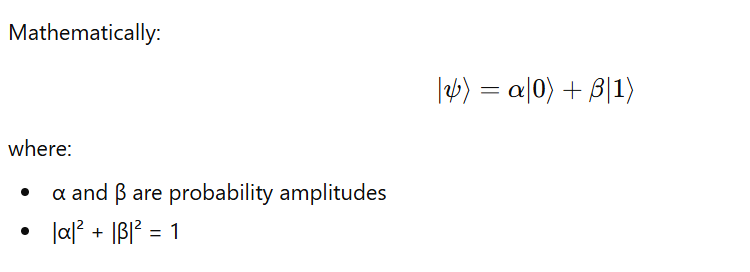
A qubit is the fundamental unit of quantum information.
Unlike a classical bit (0 or 1), a qubit can exist in a superposition of both 0 and 1 simultaneously.
 Quantum Gate
A quantum gate manipulates qubits.
It is the quantum equivalent of a classical logic gate.
Common gates:
•	Hadamard (H) – Creates superposition
•	Pauli-X – Bit flip
•	CNOT – Creates entanglement
Quantum gates are reversible and represented by unitary matrices.
Quantum Algorithms
A quantum algorithm is a step-by-step procedure that leverages superposition and entanglement to solve problems more efficiently than classical algorithms.
Examples:
•Shor’s algorithm (factoring)
•Grover’s algorithm (search)
•VQE (quantum chemistry)
 Quantum Gate
A quantum gate manipulates qubits.
It is the quantum equivalent of a classical logic gate.
Common gates:
•	Hadamard (H) – Creates superposition
•	Pauli-X – Bit flip
•	CNOT – Creates entanglement
Quantum gates are reversible and represented by unitary matrices.
Entanglement
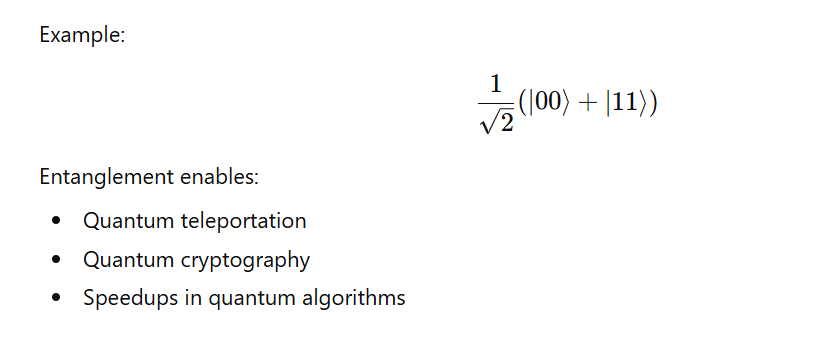
Entanglement is a quantum phenomenon where two or more qubits become correlated in such a way that the state of one instantly determines the state of the other, regardless of distance.
Decoherence
Decoherence is the loss of quantum behavior due to interaction with the environment.
It causes:
•	Noise
•	Errors
•	Loss of entanglement
Managing decoherence is one of the biggest challenges in building quantum hardware.
 Measurement
Measurement collapses a quantum state into a definite classical outcome (0 or 1).
After measurement:
•The probabilistic quantum state becomes deterministic
•Information about superposition is lost
 Quantum Circuit
A quantum circuit is a sequence of quantum gates applied to qubits to perform computation.
It consists of:
•	Qubits (wires)
•	Gates (operations)
•	Measurements (outputs)
 Superposition
Superposition allows a qubit to be in multiple states at once.
This is what gives quantum computers their parallel computational power.
Think of it as exploring many possibilities simultaneously — until measurement collapses the state.
Featured Articles / Highlights
Message Us