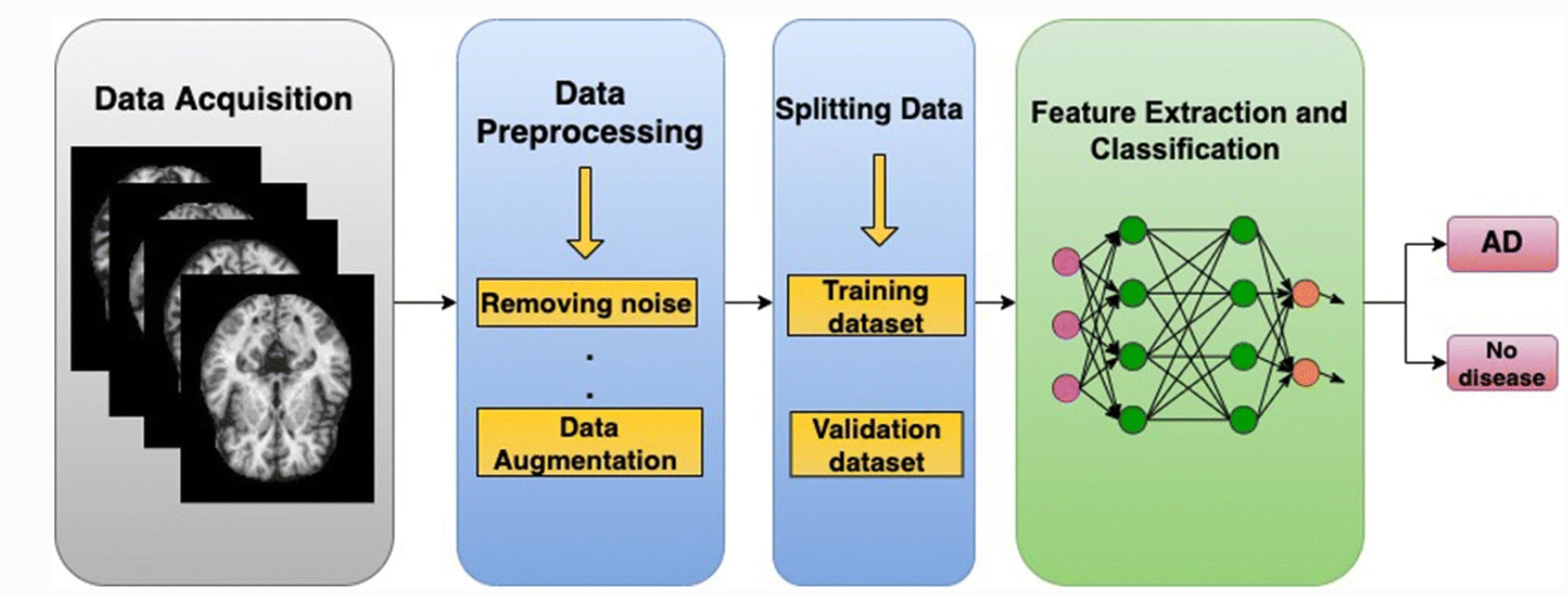
There are several deep learning algorithms that have been used for the detection of Alzheimer's disease, including convolutional neural networks (CNNs) and long short-term memory (LSTM) networks.
CNNs are a type of neural network that are particularly well-suited for image classification tasks, and they have been used to analyze brain scans (such as MRI or PET scans) to detect Alzheimer's disease. In one study, a CNN was trained on a dataset of brain scans and was able to achieve an accuracy of 87% in detecting Alzheimer's disease
Data set obtained from ADNI ( Alzheimer’s Disease Neuroimaging Initiative). https://adni.loni.usc.edu/methods/mri-tool/mri-analysis/#mri-data-set-container
1.Collect data: This can include medical records, brain scans, genetic information, and cognitive test results.
2.Train a machine learning model: Use the preprocessed data to train a machine learning model to identify patterns and correlations that may indicate the presence of Alzheimer's disease.
4.Evaluate the model: Test the model on a separate dataset to assess its accuracy and determine if it is ready for use in a clinical setting.
5.Implement the model: If the model performs well, it can be used to detect Alzheimer's disease in patients. It is important to continue monitoring the model's performance and make any necessary adjustments to ensure it remains accurate.